Tuesday, 5 November 2019
Making reading accessible with Wakelet
Looking for an alternative app to Padlet I came across Wakelet which is a great alternative if you are just wanting to compile a variety of digital media. It has a good reading feature will be really useful for unpacking text with students as it can highlight any verbs, adjectives, similes and provide pictures as well as a dictionary to cue the meaning of the word. There is even the option to have the text read aloud. Here's my first moodbood, I'll definitely be adding this one to my classroom practice.

Wednesday, 9 October 2019
Design thinking at KPMG
At this term's Manaiakalani hui we were treated to an afternoon of Design Thinking at the KPMG offices in the Auckland Viaduct. It was a lot of fun and felt more like play than hard work, creativity at it's best!
Design thinking can be used to problem solve a wide range of human related issues that encourages people to think outside the box to find solutions that encompass the needs of all involved. Five steps are involved, empathise, define, ideate, prototype and test. Empathetic design thinking starts with participants, observing and listening to the problem at hand while putting aside all judgments and preconceived perceptions. Approaching problem solving through an empathetic lens, potentially opens up those involved to consider everyone's perspectives and different viewpoints without judgement. It helps to build a profile of the situation or person/s to really define the problem and identify the issue. The ideate stage is where you go beyond thinking outside the box, no idea is too wacky or wild. It's a time for getting ideas down, then categorising them if possible to establish recurring themes. Developing a prototype and testing that prototype is an iterative process that could go through several cycles of elimination and refinement. Key to this last stage was being able to communicate the issue, ideas and prototype to someone who wasn't associated with the project or it could have been the client. In our group we found this part of the process helped us to identify things we'd overlooked or hadn't given enough thought to.
I was first involved with design thinking at a professional development day at Hobsonville Point some years back and I have on many occasions used this approach with digital design students at high school. I'd like to learn more about how to best apply the technique with students in bit sized lessons over one or two periods to kick start a project. I've often found that design thinking is something that goes over an extended period of weeks or even months but if I could narrow that down to an hour's lesson would be ideal with the changing nature of my facilitation.
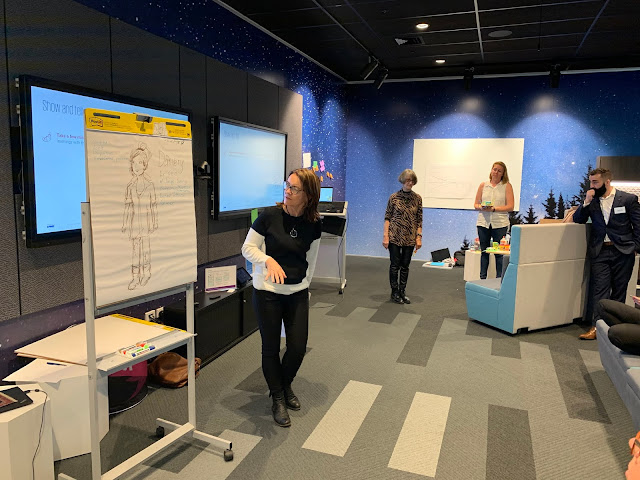
Below is an image of me trying to explain to our team's design for the group. I was lucky to have the very talented Anne Sinclair (who drew Danvery) along with vibrant Venessa Davan and Deborah Wallace in my team.
We came up with a fictional character called Danvery who left corporate life disillusioned with the exploitation of the natural world and the industrialisation of farming. Danvery developed a business making bespoke edible coffee cups from seaweed that she hoped to see in every cafe through the country in a bid to encourage sustainable practice.

I was first involved with design thinking at a professional development day at Hobsonville Point some years back and I have on many occasions used this approach with digital design students at high school. I'd like to learn more about how to best apply the technique with students in bit sized lessons over one or two periods to kick start a project. I've often found that design thinking is something that goes over an extended period of weeks or even months but if I could narrow that down to an hour's lesson would be ideal with the changing nature of my facilitation.
Below is an image of me trying to explain to our team's design for the group. I was lucky to have the very talented Anne Sinclair (who drew Danvery) along with vibrant Venessa Davan and Deborah Wallace in my team.
We came up with a fictional character called Danvery who left corporate life disillusioned with the exploitation of the natural world and the industrialisation of farming. Danvery developed a business making bespoke edible coffee cups from seaweed that she hoped to see in every cafe through the country in a bid to encourage sustainable practice.


SMART media
This term we're focusing on SMART media which involves anything related to images, movies, music, animation and so on. One element I particularly wanted to unpack a bit more was image use.
It's so easy to use any image without pausing and giving credit to the artist or even checking that it's ok to use it in the first place. More often than not, images that we want to use are not licensed for sharing. An easy way to see which images are available for free is to click 'tools' on a google image search and swap through the different licences.

Encouraging students to use the Explore tool in the Google Suite is a good idea because that automatically brings up only images that are in the public domain along with the associated reference. There are of course a number of free image sites one that I often frequent is pixabay.com they have a good collection of both photos and vectors for free use.
I've complied a Creative Commons lesson resource to help students develop an understanding for what's ok and what's not ok to use online. You're welcome to use and repurpose for your own classes and I'd love to hear how it worked for you or whether you developed it any further.
My image challenge
Only images in the public domain are free to use which can be a bit limiting when you want to create an inspiring image quickly. However, there are a lot of images available for free on image sharing sites like pixabay, photopea and realistic images
To help students put this in context, my colleague Kelsey designed an image challenge. I took it one step further and got students to add their own creative commons licence. Here's a link to the resource I developed.
This was my image challenge. I had to create a themed image, I chose gardens and nature and then applied a creative commons licence to it.


This work is licensed under a Creative Commons Attribution-NonCommercial-ShareAlike 4.0 International License.
References:
Image by Ronny Overhate from Pixabay
Image by InspiredImages from Pixabay
Image by Scott Webb from Pixabay
Image by ejaugsburg from Pixabay
Image by Jens Enemark from Pixabay
To help students put this in context, my colleague Kelsey designed an image challenge. I took it one step further and got students to add their own creative commons licence. Here's a link to the resource I developed.
This was my image challenge. I had to create a themed image, I chose gardens and nature and then applied a creative commons licence to it.

This work is licensed under a Creative Commons Attribution-NonCommercial-ShareAlike 4.0 International License.
References:
Image by Ronny Overhate from Pixabay
Image by InspiredImages from Pixabay
Image by Scott Webb from Pixabay
Image by ejaugsburg from Pixabay
Image by Jens Enemark from Pixabay
Thursday, 29 August 2019
Digital Fluency Intensive cohort#3
Our third DFI cohort got underway yesterday at Bay of Islands College. We were welcomed to the school in the school's marae with a whakatau and some beautiful waiata. Hearing Manaiakalani's waiata (composed by Jasmine Maunsell and her whanau) being sung by the students was wonderful. Their harmonies filled my heart with emotion and brought tears to my eyes.
We are so blessed to have such diversity in our DFI cohort and there is something to be said for the wealth of experience that everyone brings to the group. We have new entrant teachers right through to year 13 students, along with a couple of deputy principals and one principal. Aside from their teaching professions we have a firefighter, many who love to travel, dance, surf, paint and sailors.

 We were lucky to be hosted in one of the classrooms in the marae which has recently been refurbished. The WIFI held up for our Google Hangout with Dorothy and all in all it was a very positive day. I'm looking forward to working with everyone over the coming weeks.
We are so blessed to have such diversity in our DFI cohort and there is something to be said for the wealth of experience that everyone brings to the group. We have new entrant teachers right through to year 13 students, along with a couple of deputy principals and one principal. Aside from their teaching professions we have a firefighter, many who love to travel, dance, surf, paint and sailors.


Saturday, 24 August 2019
Unpacking the key principles of Hei Raukura Mō Te Iwi
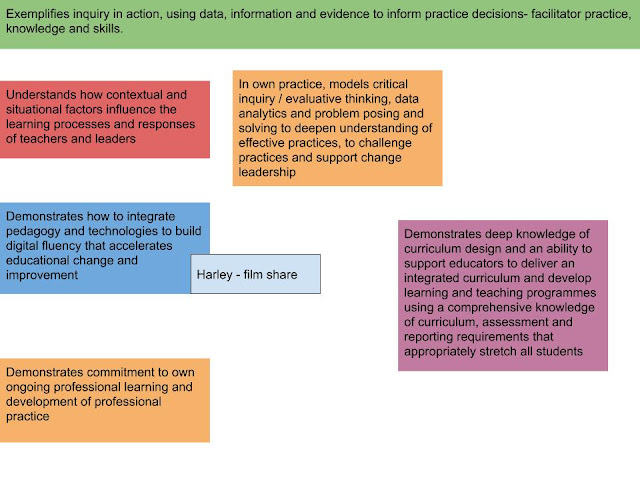
For the past 6 months or so I've been working on my applying for accreditation with the Ministry of Education. It's been quite a process and there have been a number of rewrites. Firstly understanding what was required has taken some time especially as the requirements have changed within the last 8 months. To help me understand the three strands within the I unpacked the specifications, rearranging the criteria visually. I felt it gave me time to mull things over and see what I could share from my own practice that aligned with each objective.


Dimension 1 - Te reo me ngā tikanga mātauranga
Demonstrates commitment to tangata whenuatanga and bicultural partnerships and practice in Aotearoa New Zealand.

Dimension 2 - Te Mana o te kura me te whanaungatanga
Builds leadership and quality teaching that is responsive to context and culture to achieve greater equity and improved achievement and well being for all students

Dimension 3 - Kia matatau ki āna kaupapa
Exemplifies inquiry in action, using data, information and evidence to inform practice decisions- facilitator practice, knowledge and skills.

Wednesday, 17 July 2019
Smart Surfing in Social Studies
Within my role as a Manaiakalani Outreach Facilitator, the majority of time is spent working in the secondary school sector. Facilitation in a secondary school setting does look slightly different to what might occur in a primary school setting. One of the reasons for that is the pressure high school teachers are under to deliver a curriculum that prepares students for NCEA. It's often thought it difficult to run lessons throughout the year that focus just on the Cybersmart curriculum. Instead it's more about integrating the Cybersmart curriculum across subjects and embedding them into teachers' lessons.
Working with a teacher of a Year 9 Social Studies class today's focus was on Smart Surfing.
This class are learning about our Kiwi Culture and identifying what aspects make up their own culture. I modified the Smart Surfing lesson from Manaiakalani's Cybersmart curriculum adapting the key search words to align with their topic focus. I also extended the search functions to show students how they could search for different time periods which was interesting especially as there were no news updates for the mid 1950's and 1960's. Next steps are getting students to think about whether or not their search findings are reliable.
Subscribe to:
Posts (Atom)